

“Grief fills the room up of my absent child,
Lies in his bed, walks up and down with me,
Puts on his pretty looks, repeats his words,
Remembers me of all his gracious parts,
Stuffs out his vacant garments with his form;
Then, have I reason to be fond of grief?
Fare you well: had you such a loss as I,
I could give better comfort than you do.
I will not keep this form upon my head,
When there is such disorder in my wit.”
-King John, Shakespeare
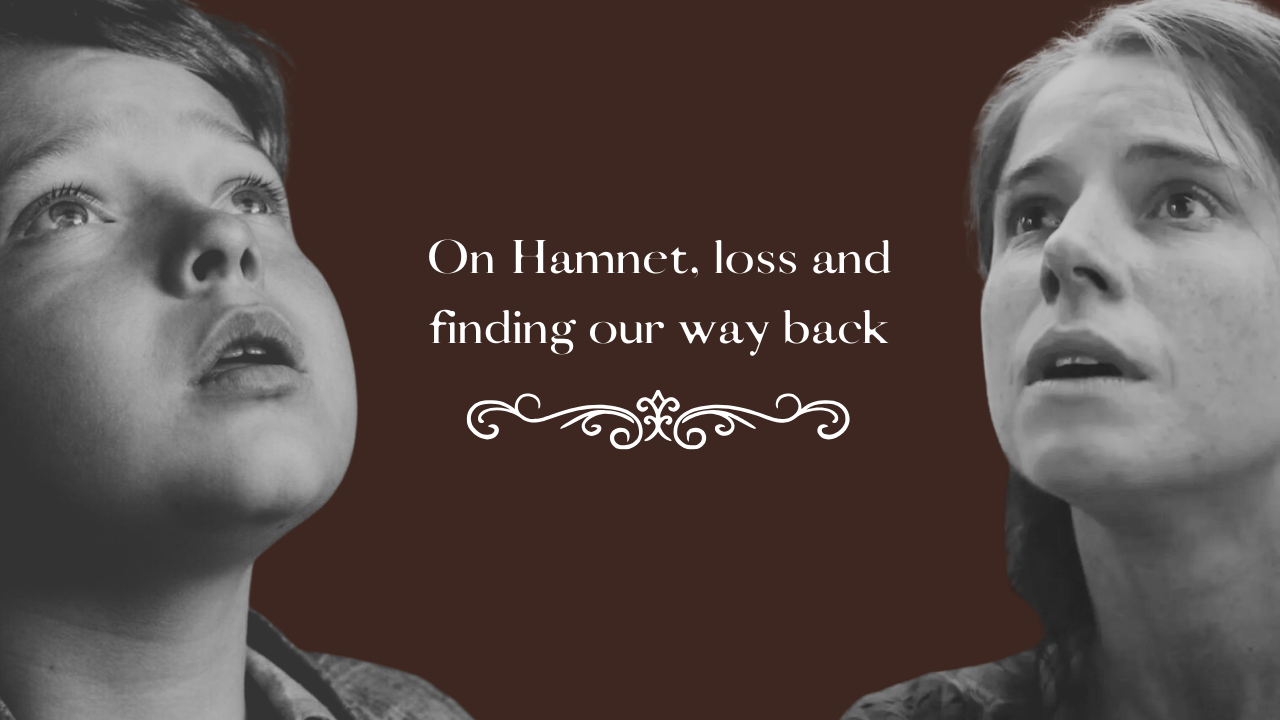
Shakespeare's only son, Hamnet, died when he was eleven. How his death relates to Hamlet, if at all, can only be a matter of speculation. No letter, records or accounts survive or exist (arguably) to where one may point and say look here, he is mourning the child he lost.
We know that before every story of loss is the love that led to it. Hamnet begins with the legend of the musician and bard Orpheus, who travelled to the underworld because he could not bear being parted from his wife Eurydice. The legend is how the film invites us to William and Agnes' love story, taking a deep breath, holding our hand and telling us to look closely.
There is love, laughter, children and a happy home alongside a deep restlessness running through William that one can believe is the unfolding of his genius. It drives him away from home, makes the pen and the stage as much his companions as his wife, both laying an equal claim. But this is not the story of William Shakespeare.
Grief is a cruel and humbling experience and yet a fundamental, timeless and utterly human response to the one rule we all abide by - loss. It makes everything seem glib and phony, it refuses to be captured in language, and it cannot be bent to accommodate our feelings. It has to be carried, nursed, and held over and over and over until it can keep you company. Grief, in all its shapes and colours, is still at its heart - love. I will journey to the underworld, I will always look for you, I will trick death for you, and I will be brave, nay braver.
Hamlet is and will always be a tragedy. Hamlet must die because Hamnet is dead. He saved his sister and left behind a grieving family, and because his father couldn't do anything with this overwhelming loss except pour it into his art, it gave us one of the most enduring, famous works of literature in the Western canon. In what is one of the most haunting, poignant and tender scenes I have ever seen, we have Hamnet switch places with Judith as he makes a secret promise that echoes through the ages. It takes the ephemeral and gives us the perpetual.
It was at this moment that I broke down in a dark theatre somewhere in Noida. It wasn’t difficult to imagine myself in his place, not at all, because I, too, am half of a duo, and I have loved my sibling so fiercely, tenderly, and it has always, without fail, made me braver. Love does that to us, I suppose.
Freud characterizes the resolution of grief, what he calls the work of mourning, as an internal conflict: a tension between our natural psychological tendency to maintain emotional attachment to those we have lost and the unavoidable demand that we accept the reality of their absence. It is important to note that Freud viewed grief as something to be overcome, brought on by a momentary lapse of self and that mourning, all mourning, must end.
.
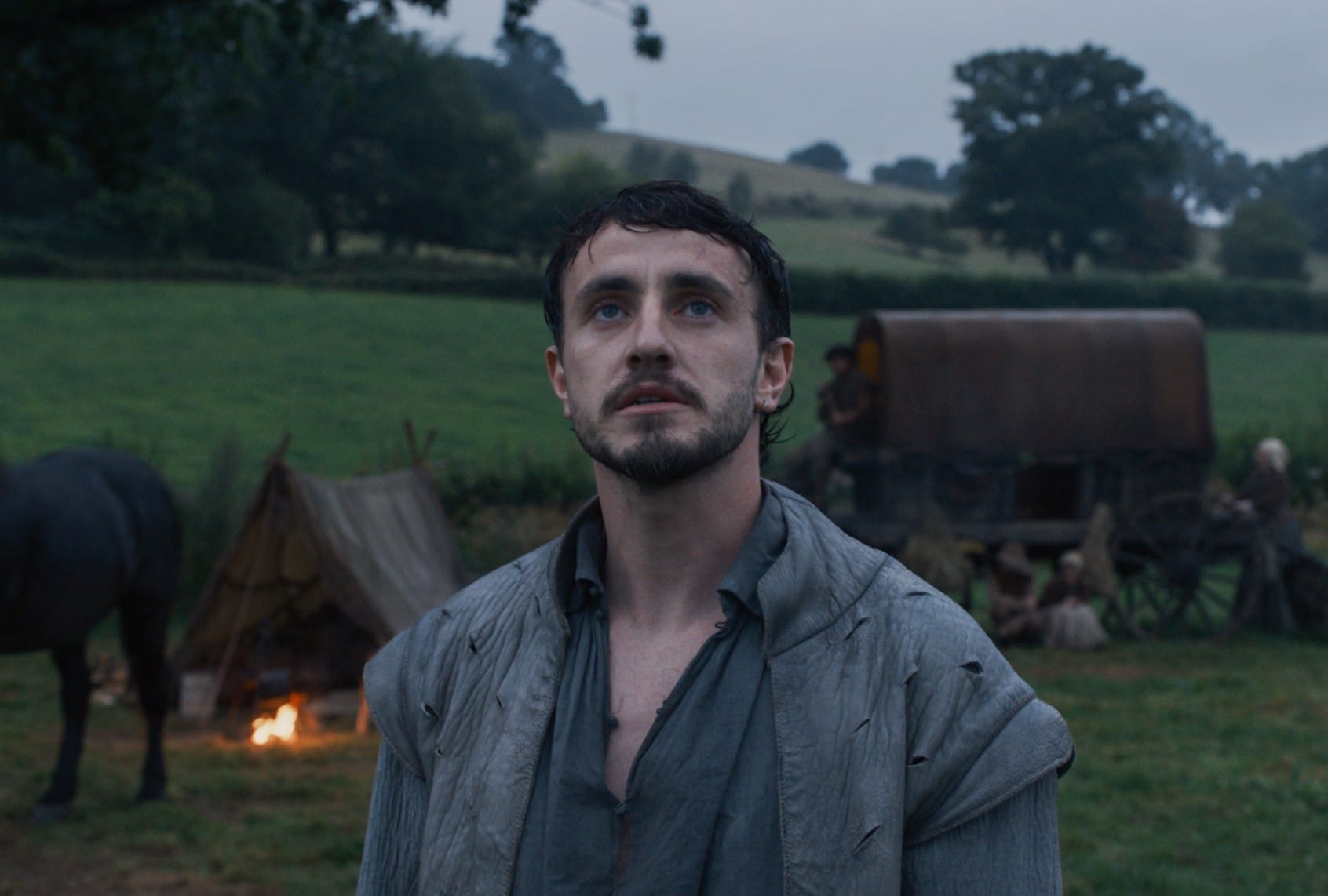
Hamnet takes us behind the creation of Hamlet. A daring imagining because the central play is of no genre. As Bloom calls it, “of all poems, it is the most unlimited”. Hamlet is both prince and king; he is dead and also alive. He is a son mourning his father; he is a father mourning his son. It is no coincidence that the word heartache itself came into our lexicon through this play. The names were interchangeable in Elizabethan England, and Zhao holds that interchangeability as both comfort and indictment. The father who could not save his son gave his son's name to a prince, and that prince has been dying on stages across the world for centuries. Each performance is a repetition. Each repetition is a second iteration of the original tragedy.
In ‘The Work of Mourning’, Derrida argues that grief places us in an impossible double bind; to successfully get over a loss is, in some sense, a betrayal, because it means assimilating the dead into ourselves, making them part of our interior life rather than honouring their irreducible otherness. It means allowing the dead to remain, in some sense, exterior to us, unresolved and unincorporated, present as an absence rather than a memory we have smoothed into something manageable. To mourn well, paradoxically, is to fail to mourn in the therapeutic sense, to refuse the closure that would let us move on, because that closure purchases our peace at the cost of the other's singularity. The dead person was not a feeling we had. They were a world, and that world cannot be folded inward without something essential being lost in the translation
After the loss comes the living.
With Hamlet, William, the father, looks back. That is the tragedy behind the tragedy: an Orpheus who could stop himself from looking back probably wouldn't have gone down there for her in the first place. He knows his child is gone, and he wasn’t there; he heard he went in pain, and he wasn’t there. He accepts his boy is not coming back, but that he is here.
In history, the second act is a farce. But farce, with Hamnet, is not mockery. It is the grief made speakable, the unbearable made bearable enough to sit with for two hours in a darkened room.
My close and personal friend (jk) Roland Barthes wrote in ‘Camera Lucida’ that grief is endless, and it has no arc, and who we loved and lost can never be substituted. To grieve truly is to remain helplessly loyal to the particular, a face, a gesture, the being, not the figure, not a character in a play, but the irreducible, untranslatable fact formed from us knowing them. “The world does simply not stand still, Agnes”, says William as his wife is blinded to his struggles, lost in her own grief. The film is, formally and emotionally, that second act. We become an audience inside an audience watching Agnes witness an entire theatre of people grieve the death of her son.
There's something so, so painfully human about seeing things finished. To see an end. This film reminded me that everyone who has encountered this play across four centuries has likely carried their own grief, their own pain, their own experience of madness and just like the audience reaching toward the stage, we all find ourselves wanting to hold onto something, to confirm that it was real, that it mattered, that we were here.
And so long as the play is played, Hamnet/Hamlet never dies alone

About The Author: Kanupriya Kaikeya is a communications professional working at the intersection of cities and climate, shaping how urban climate action is understood and engaged with, across South and West Asia. In an effort to own her time and not sell it, Kanupriya enjoys writing, reading, watching movies alone and visiting art galleries and monuments. Angry, annoyed and trying to pay attention to the world without flinching.
Support the author: We're an independent magazine that is finding its footing, and here's how you can help: Shatter the illusion of capitalism with one contribution at a time and consider supporting this writer who made you laugh/cry directly: kanu.kaikeya@okhdfcbank
Comments