

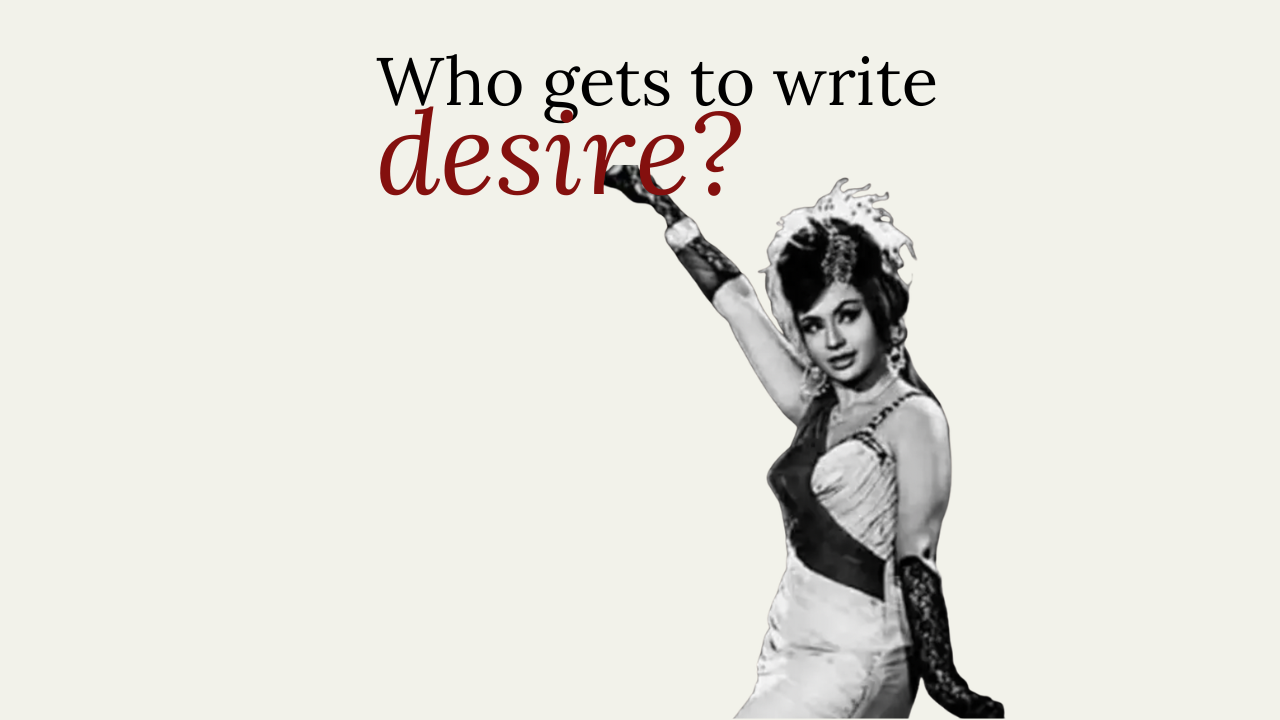
A researcher-practitioner exchange on lyrics, gender, and Hindi film culture.
Note: This piece covers questions on lyrics, gender and Hindi film culture through the lens of professor Prerna who brings in the research and expertise as a culture critic and Smriti Bhoker who draws from her time as a lyricist.
A shared mp3 player sits between two sisters. “Khoon Chala” and “Luka Chuppi” loop for days before the film is released. One child cries, unaware of the plot. The song has done its work anyway. It has given grief a language, held feeling in suspension, and attached emotion to a world that the listener has not yet fully seen. Hindi film songs have long worked in this register. They circulate through radio, cassette, television, neighbourhood sound, family memory, and repeat listening. They carry the film beyond the theatre and sometimes ahead of it. The lyric, in that sense, belongs to language, labour, and public life all at once.
The song before the film
Researcher
The Hindi film song occupies a dense social position. It condenses narrative, distributes affect, and gives the audience a portable fragment of the film’s emotional world. Lyrics also give criticism a sharper object. Film criticism can stay with image. Poetry criticism can stay with language on the page. Lyrics force both questions together. A line is heard through voice, melody, breath, timing, choreography, star persona, and circulation. The lyric therefore gives us a compressed archive of social feeling. It tells us how desire is softened into romance, how shame is folded into metaphor, how class aspiration acquires sound, how a woman becomes audible while authorship remains elsewhere.
Practitioner
My first serious encounter with lyrics came when I was ten, listening to “Khoon Chala” and “Luka Chuppi” from Rang De Basanti before I had watched the film. I kept replaying them and crying. Later, after seeing the film, I could place them inside the story. The earlier experience stayed with me more forcefully. Lyrics had carried the feeling on their own. That is what keeps drawing me back to them. They hold the film's context without needing a frame in front of you. They also rescue films that collapse under their own ambition. I think of Bombay Velvet here. The film did not hold together for many viewers. The songs did. The lyrics preserved seriousness where the film lost it.
Scandal and delayed visibility
Researcher
The lyricist often becomes publicly visible only in the face of accusations. Public discussion isolates the lyric from the wider industrial machinery that produced it and turns language into evidence in a case about women’s bodies, sexuality, and national culture. Visibility comes through scandal. Craft stays secondary. Popular memory preserves stars, hooks, choreography, embarrassment, and outrage. It preserves the woman as spectacle and the song as controversy. The writer surfaces belatedly. Women surface under even harsher conditions, as bodies through which the public rehearses its anxiety about sexuality, class, and control.
Practitioner
Songs have long lived under the shadow of the film, but the form of that shadow changed with television and video culture. Earlier, a lyricist’s name on a poster could signal seriousness because people often heard the songs before they watched the actors inhabit them. Later, once the song became fully visible as a media object, the scandal around the lyrics hardened into a recognisable genre. Choli Ke Peeche and Sexy Sexy Mujhe Log Bole belong to that shift. The same men profit from the scandal, another set of men condemns it, and women live with the afterlife. A line from a song gets pulled out of the cinema hall and used for catcalling on the street. That is where the public debate often ends up.

Who writes desire
Researcher
Hindi cinema has a long archive of songs built around female longing, ache, sensuality, and erotic anticipation. The sharper question sits elsewhere. Who writes those feelings, and under what terms do those feelings become publicly acceptable? Female feelings circulate widely. Female authorship does not. Desire is easiest to legitimise when it can be routed through waiting, adornment, surrender, flirtation, or pain that confirms an already familiar feminine script. Appetite with self-possession, appetite without shame, appetite without the need for male recognition, appears far less often. When sexuality grows too direct, too embodied, too indifferent to approval, the song often shifts toward spectacle. The woman becomes visible in high relief while control over the terms of visibility stays elsewhere.
Practitioner
Most songs about desire, even those supposedly sung from a woman’s position, still move through a male grammar of desirability. That grammar repeats a few figures again and again: the chased girl written as though pursuit is flattering, the “bad” girl, the sexually available woman who must stay desirable to men, the woman drinking or dancing alone so long as the scene still flatters male fantasy, the woman whose body can be named and consumed because the beat is good enough to hide the violence of the writing. I do not know any women who hear most mainstream item songs and feel represented by them. These songs circulate among men, are written by men, and are sanctioned by men, even when a female playback voice is used to assign agency after the fact. That is why a song like “Jhallah Wallah” stands out to me. It writes desire without insulting the woman in the song or the women listening to it.
Women lyricists and the question of labour
Researcher
The scarcity of women lyricists is routinely reduced to a representational deficit. That language is too weak for the structure it is trying to describe. The issue sits at the level of labour and access. Who gets invited into the room? Who is given time to build craft? Who survives the informal economies of recommendation, proximity, and replacement? Who can afford precarity long enough to turn one commission into a practice? Lyric writing depends on elastic hours, social networks, repeated availability, and the capacity to stay in circulation across projects. Those terms of work align badly with a social order that regulates women’s mobility, leisure, safety, and claim to artistic seriousness.
Practitioner
Ask people for the names of commercially successful male lyricists, and the list comes quickly. Ask for women, and the field narrows at once. I grew up hearing names like Rani Malik and Maya Govind. My generation holds on to Kausar Munir and Anvita Dutt. The shortness of that list says enough. Writing lyrics is unstable work. Writing itself is unstable work. Very few people can sustain a household solely through poetry or lyric writing. For women, the barriers begin earlier and cut deeper. Access often comes through accident, industry proximity, late-night rooms, and the willingness to say yes in spaces already structured by male confidence and male power. Staying in those spaces can also require enduring disrespect and sexual misconduct that should have no place in artistic labour. I often think there are younger and better lyricists than me outside those rooms. I was simply in one, and I had enough privilege and enough endurance to stay there.
What a richer conversation would ask
Researcher
Obscenity debates flatten the field. They isolate a line, moralise over it, and leave the industrial system intact. A stronger public conversation would begin elsewhere. Who briefs the lyricist? Who sits in the room? Who can refuse the brief? Who receives credit across platforms? Who disappears into metadata. The question, therefore, exceeds vulgarity. It is a question of labour, recognition, and the social organisation of authorship. It is also a question of address. Who is speaking, to whom, under whose conditions, and with what permissions? That is where gender, class, labour, language, and power gather inside the lyric.
Practitioner
I do not think the public argument improves by asking whether a song is “bold” or “too much” in some abstract moral sense. A lot of these songs are simply bad writing protected by market confidence and male permission. If the lyric were genuinely for women, or shaped by women’s sense of desire, we would be reading it differently and seeking out the women behind it with care. The digital sphere has changed part of this landscape. Criticism no longer belongs only to television panels pretending to defend morality. People can think publicly now, and audiences can hear arguments that go beyond shouting. Even so, the larger problem holds. Films themselves are increasingly thin on labour, intimacy, power, or social contradiction. Lyrics produced inside that machine inherit its limits. Half the population lives estranged from desire in public life, in family life, in language itself. The state of the song follows from the state of the culture.

About The Researcher: Prerna Subramanian is a cultural critic and professor behind @doctorofpopculture. She writes and teaches on gender, caste, pop culture, cities, and digital life, tracking how power moves through desire, visibility, and everyday media.
Support the author: We're an independent magazine that is finding its footing, and here's how you can help: Shatter the illusion of capitalism with one contribution at a time and consider supporting this writer who made you laugh/cry directly: prernasubramaniancad-1@okhdfcbank
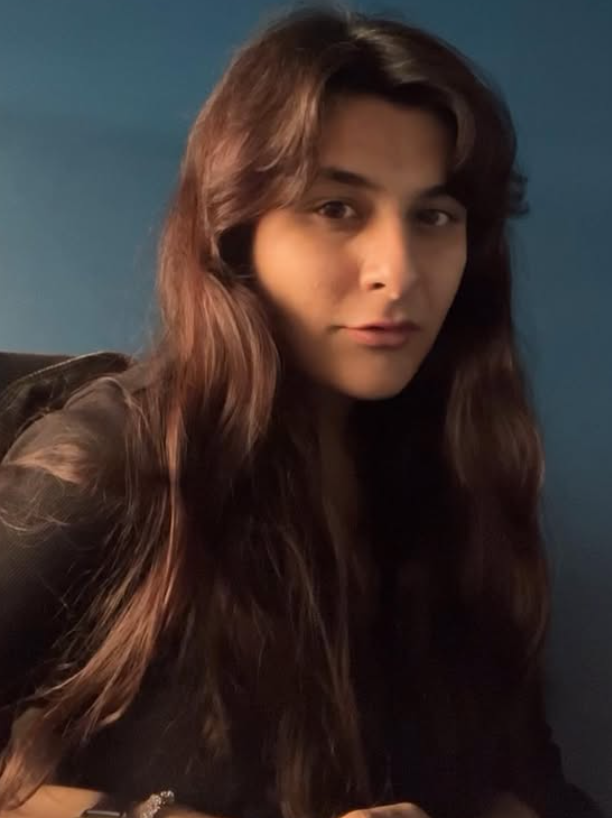
About the Practitioner: Smriti Bhoker is an Urdu poet, lyricist, screenwriter, and culture essayist based in Mumbai, India, where she heads a techno record label. With a master's degree in sociology, she brings a deep understanding of culture and society into her creative work. Smriti has published two Urdu books that fall under the genre of political poetry. Smriti’s work often explores themes of identity, language, and social narratives.
Support the author: We're an independent magazine that is finding its footing, and here's how you can help: Shatter the illusion of capitalism with one contribution at a time and consider supporting this writer who made you laugh/cry directly: smriti.bhoker@okaxis
Comments