

In India, we grow up knowing the Ramayan. We watch it on TV, read about it in school, and hear it as a part of the popular discourse- deeply religious for some and vaguely remembered stories for others. I grew up hearing these stories, too, but I didn’t engage with them. Ram and Sita were abstract characters from an old epic. Then I read Ashok Banker’s Ramayan – an 8-book series, close to the traditional Valmiki version; and I fell in love with Ram. Not with the legend but the man. The hero with humility, who feared, questioned, and wrestled with the moral weight of his actions. I understood why so many people over centuries have revered him. But, for me, this perception broke towards the end of the story. I couldn’t reconcile the Ram I had come to love with the man who abandoned Sita – his partner, his wife, his other half, for a society that couldn’t accept her.
As a woman, I also felt deeply unsettled. It’s not that women are overlooked in the story. The Ramayana presents us with strong, vocal female characters with courage and agency. Kaikeyi, Mandodari, Manthara, even. They demanded their rights, they counselled the men in their lives, and they did not stay silent. They were not one-dimensional paragons of virtue; they were multifaceted, human, flawed – and they paid in full for their transgressions against society, against Dharma. Which got me thinking about all the women in Ramayan. While the women felt the full weight of their actions and choices, was the same moral judgement applied to the men? Let’s explore this through the lens of some of Ramayana’s women.
The first is Ahilya. She was the most beautiful woman in the world. Daughter of Brahma, given in marriage to Rishi Gautam, the most revered sage of his time. Virtuous, dutiful, the ideal woman. She accepted her match and left her father's courts for the strict life of a wife to an ascetic. Gautam was a man of austerity and ritual; she was a wife left at home, duty-bound and lonely. Indra, the King of Gods, saw this. He noticed her, as he did with all beautiful women. After many days of observing their daily routine, Indra disguised himself as Gautam and came to Ahilya. In some versions, she is surprised by this break in routine, but does not think to question her husband; in others, she suspects the deception but chooses to accept it anyway. If the second version is true, we must ask what her life was like that a moment of warmth, even a suspect one, made the risk worth it?
Gautam came back. He saw them together, but before she could say a word, he cursed them both in anger.
Indra was cursed in Valmiki’s version with castration and in other versions with a thousand vaginas or ‘yonis’ on his body. In both versions, his status is restored either through penance or the intervention of the gods. Even cursed, he has the agency and the means to appeal to the Gods to intervene on his behalf. He turns his humiliation into an epithet – his thousand yonis were transformed into a thousand eyes, making him – Sahasraksha. His punishment was a transaction between two men over the dishonor of a husband, not the violation of a woman.
And Ahilya – In the oldest retellings, she becomes invisible, cursed to live and breathe, sleep on ashes, with the world moving around her but never seeing her till Ram’s presence liberates her. In other versions, she is turned to stone till his foot touches her. In some, she suffers, in some, she waits, in some, she prepares in devotion for the arrival of Ram. But in no version is she afforded any agency or choice. In all versions, she is punished for being violated, for being deceived. In all versions, neither Gautam nor Indra is held accountable to her. Justice for her was not even a consideration.
Ahilya's story could have been an exception, but let's look at the story of another woman. A sharp contrast to Ahilya. Surpanakha - The Rakshasi princess, Raavana’s sister. Ram, Lakshman, and Sita are guests in her forest during their 14-year exile. When their paths cross, Surpanakha is enamored by Ram’s beauty and grace. She approaches him as her true Rakshasi self – Valmiki describes her in deliberate contrast to the accepted beauty standards, but she is confident in her self-worth, in her position, and propositions to Ram as an equal. A woman openly expressing her desire was not considered wrong in her world. Ram, married with his wife present, directs her to Lakshman, who is also married. Ram knows she would be rebuffed by him, which she is. Sent to Ram again, she is now twice insulted and furious. In her rage and frustration, she lunges at Sita, her perceived rival. In that moment, to protect Sita, Lakshman attacks. He cuts off her nose and ear – a specific form of mutilation to signal loss of honor.
But Surpanakha was the enemy. She was easy to dismiss. I nearly missed it myself.
Maybe Ram thought an outright rejection would be beyond the boundaries of acceptable behaviour, maybe he thought it kinder to gently redirect her, whatever his intention, he knew he was only setting her up for rejection. Whatever Lakshman’s justification, he chose a specific action – to mutilate her. Ram and Lakshman, the most accomplished warriors of their age, had options. They chose a particular one. Surpanakha carries the physical mark of her humiliation every day, while Ram and Lakshman carry righteous absolution.
One could argue that Sita’s abduction was Surpanakha’s retribution. Ram and Lakshman spent months in anguish searching for Sita, frantic and grieving. The whole second half of the Ramayana could be considered a consequence of their actions. But who really faces the consequences here? Sita is abducted, her honor is questioned, she must pass the Agni Pariksha (trial by fire), and she is the one finally abandoned. One woman bears the consequences of another’s injury. The men wage wars, restore their dignity, and go home as moral victors. The women bear consequences and receive retribution that is never really meant for them.
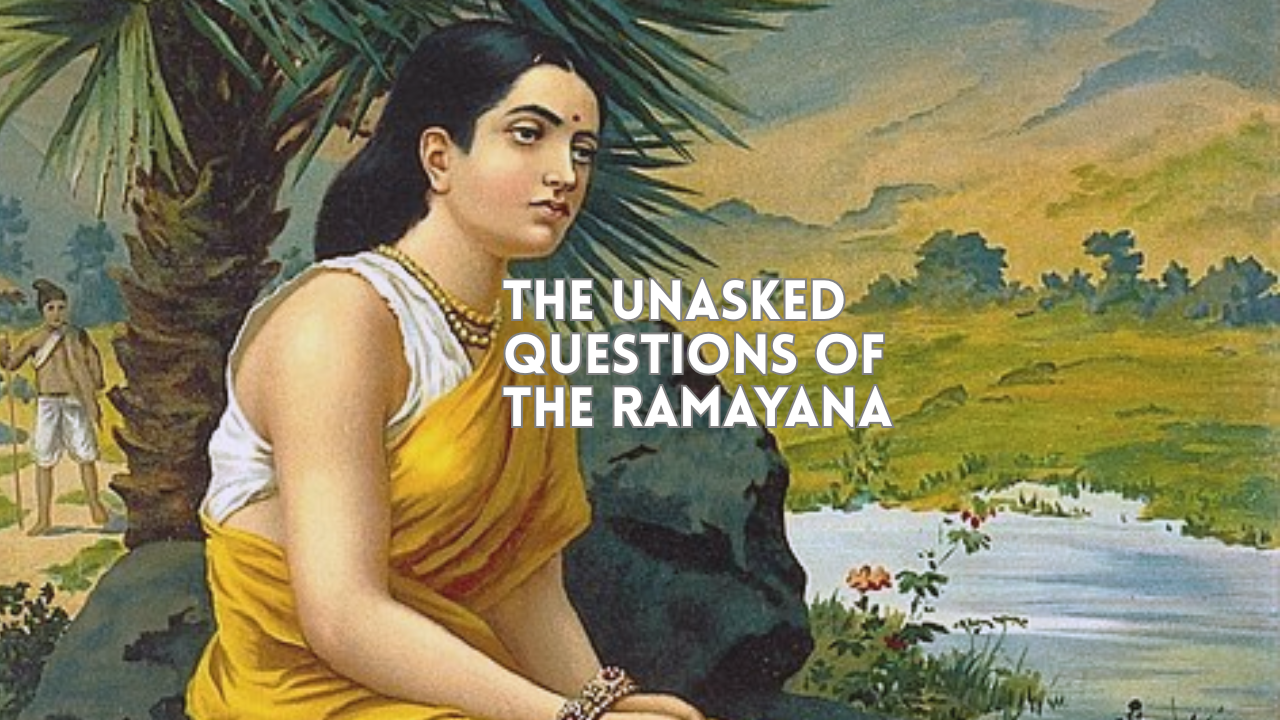
This brings us to Sita. She is the big one. The one we all know. The princess of Mithila, daughter of Janak, was born of the Earth. The Sita we know today is meek, veiled, following quietly behind Ram wherever he goes. Valmiki's Sita is different. Fierce, educated, opinionated, and present. She challenges Ram for the right to accompany him to the forest, knowing full well the hardships of the life to come, for love, out of choice, not obligation.
When she is abducted, she stands firm. She holds her head high, and her conviction in Ram is strong. She does not play victim. She bides her time like a queen with dignity. When Hanuman comes to rescue her, she refuses to be carried away like property and instead chooses to wait for her husband so he may have the honor of saving her. The extra time cost her, but she knew it would cost her husband more if she left now.
She wins. Ram saves her; he moves mountains for her and crosses oceans for her.
Then he asks her for the Agni Pariksha. Publicly, before he can take her home to Ayodhya. Before anyone demanded it.
We all know how the story ends: Sita is abandoned in the forest, alone and pregnant. Cast out of a society that has no place for a woman wronged. The epic does not shy away from the subsequent grief and guilt that Ram feels, the loyalty he shows towards Sita. It is an integral part of his moral struggle. The framing is that of a king, not just any king, but the Ideal King, choosing to uphold societal norms over what he knows to be true, to be right.
But Ram was not just any man. He had crossed an ocean for her. He had allied with forest dwellers and bears as equals. He sat with Shabari, a low-caste woman, and ate from her hand, overriding any ritual laws of his world for her humanity. Ram was a man with options. He was the Maryada Purushottam — not the follower of the highest standard but its upholder and shaper. He had the authority and the precedent to extend this standard to include his wife's dignity. He chose not to. He chose to uphold an unfair system, one where even a trial by fire was not enough.
Many would argue that the Ramayana is not the story of these women. It is the story of Ram, and it is one of the most profound pieces of literature ever written. One that has influenced Indian thought, culture, and consciousness for millennia and still does. It is this ongoing influence that makes a closer inspection imperative. The moral framework and standards established by this epic did not stay on its pages. It is the living reality of Indian women till today. Ahilya’s quiet endurance, Sita’s mute suffering, and Surpanakha’s punishment for owning her sexuality are the templates by which women are judged by their, fathers, husbands, and society. These women are upfront and central to the narrative. They need to be. They are the anchors through which the story of Ram is told. Accountability towards women was never meant to be a part of the narrative.
To examine this is not to discard the Ramayana. It is to take it seriously enough to read it whole. The text does not answer the question of what these women were owed, and we still live in a world shaped by this silence.

About the author: Sonam Agarwal is a founder who lead companies in AI, edtech and design thinking. She was a partner at EY. In her free time she is an avid reader, a yoga practitioner and a learning potter. She writes and dwells a lot on the state of women in society, science and culture.
Support the author:We're an independent magazine that is finding its footing, and here's how you can help: Shatter the illusion of capitalism with one contribution at a time and consider supporting this writer who made you laugh/cry directly: ayushigupta0908@okaxis
Comments